Showing posts with label star trek. Show all posts

Friday, 5 December 2014

After seriously considering what I can offer the world to make it a better place, I've decided to start a really expensive line of shoes

Why yes, I am watching all the Star Trek films this week in chronological order For Like The Umpteenth Time, how perceptive of you!
I'm only begrudgingly and incidentally enjoying them, though, as the rewatch has been prompted by needing to check out the quality of a blu-ray box set edition of all 10 original movies (to make sure the discs aren't borked) to evaluate its fitness as a Chrimbo prezzie, but I have to say that I liked The Motion Picture a lot more this time out, even if it still drags a bit.  The close proximity of the viewings this time around made me notice how some of Final Frontier was directed to call back to the style of The Motion Picture, and that Undiscovered Country's final line from Kirk is actually a clever allusion to the line he delivers at the end of Wrath of Khan.  The actual final shot of the Enterprise from UC is, in my humble opinion, absolutely perfect even if the actual film is well-made and played nonsense, but I never noticed before how great Yosemite National Park looks in FF, even when that final, brilliant panning matte shot is ruined by the obtrusive insertion of credits about fifteen seconds too early and what was - by then - the theme of The Next Generation, a show the producers clearly wanted to start making movies about so they could finally ditch these old geezers.
And then Generations.   Blech.  The deleted scenes include the original ending, in which Kirk goes out like a trooper fighting a physically superior opponent in hand-to-hand combat, finally getting the upper hand with the deployment of the patented Kirk Double Axe Handle Blow before buying the farm on a wisecrack when he's treacherously gunned down from behind, which is a bit of a contrast with the actual re-shot ending they went with, in which Kirk and Malcolm McDowell play tag for a few minutes before Kirk trips on a stair and breaks his neck because he is a hundred.  The official ending basically makes him look like a chump to put the new crew over with audiences, though possibly if that is the desired effect, it's ruined by the new crew losing their ship on their first adventure and constantly being taken to the cleaners by panto Klingon villains and stock footage from previous Trek movies - the stock footage thing is particularly at odds with the notion of the franchise moving forward, I would also think.  I am going to do a Fanboy Thing from this point onward and just ignore all of Generations in much the same way that the rest of Trek itself has chosen to do.  It is for the best.
Of the others, Voyage Home is very much of its time, particularly the scene where Kirk tries to hide his futuristic communication device (a mobile phone) but made relevant by the chemistry between the leads, and Search For Spock remains a functional but not very interesting addition to the series.

I briefly considered watching the two reboot flicks after the original movies, but discounted this for two reasons:
1 - the intended recipient of aforementioned Chrimbo prezzie already has the first one on blu-ray, and
2 - despite being capable of watching absolutely anything if it's sci-fi - to the extent that at one point it was lamented that Tank Girl was not yet available on blu-ray - when I took them to the cinema to watch the second one, they leaned over to me during the bit where Kirk is trying to kick a giant sparkplug to make a space engine work again and said "this is going on forever, isn't it?" and it remains the single Trek film I've seen only once.  Which was too many times.

Wednesday, 8 January 2014

I have parkinson's, I'm not a witch

Star Trek: The Next Generation dated pretty quickly, by which I mean that it dated before it even went off the air, filled as it was with "unique" characters meant to function as self-contained story engines somewhere down the line from the pilot.  It had the only android in Starfleet, the only kid genius, the only Klingon, the only half-human empath, the only Frenchman who had manners, and so on.  It was all very 1980s - which was unfortunate, as Star Trek: TNG continued well into the 1990s.
By contrast, Deep Space Nine had a rather regular bunch for its central cast if you looked past Odo, who the writers clearly struggled to do anything with once they'd got past the pilot and realised that those Terminator 2 SFX were kind of lame actually and so went for broke with his backstory in the show's third season.  DS9 had a mid-level bureaucrat as its main lead, abetted by a bitter but unremarkable ex-terrorist, a dull but inoffensive scientist type, the second-best doctor in his graduating class, a capitalist, and the space-age equivalent of an Irish sparky - though admittedly when ideas were being thrown at the wall later, some of these character types were given overhauls that were either genius or deeply unconvincing depending on your bullshit tolerance: for me, Bashir's turn as a secret super-genius was a low point, while Sisko's life being retroactively altered by trans-linear aliens just because he's incapable of having faith in others was a high point.  These are, for the most part, just run-of-the-mill types from the Star Trek universe, and as a result they've traveled well in the BUGGER ME SIDEWAYS 21 years since the show debuted, but Past Tense, a 2-part time-travel outing from the 3rd season, has not dated quite as badly as I'd hoped, and it makes me hope that no-one in the current government ever sits down to watch it in case it starts giving them any of the wrong kind of bright ideas.

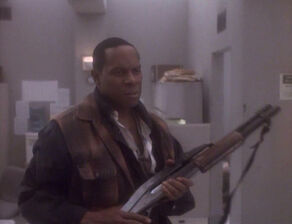
Past Tense  tells the story of how, after a transporter accident deposits them in America's distant past (but the viewers' near future), Bashir and Sisko encounter police officers who take issue with the pair not having any ID, so they're taken to a holding area that is effectively a concentration camp for the poor and get caught in a riot when people try to make themselves heard and are killed by the hundreds in the violent government response.
Despite (or because of) the cops being fellas in overalls wandering around with shotguns effectively mugging any brown people they come across, it's a depressingly plausible scenario for many reasons beyond that it's happening to the only obviously non-white faces on the cast while their attractive Caucasian crewmate finds herself surrounded by affluent white people, so there's a wee bit of class commentary going on here even though it's essentially just setting up a major coincidence or two for later in the story.  It's interesting how the episode does these long panning shots of homeless people just laying around on any bit of the streets where they fall and it looks like a post-apocalyptic fantasy rather than an attempt at relevant social commentary, but the longer you watch, the more the huge logical cracks start filling in with depressing (though likely serendipitous) insights like the "sanctuary districts" being a PR exercise by the ruling classes to keep their cities attractive to investors by simply hiding the poor from view, which we know is already going on, even here in the UK, where the government regularly covers up sexual assaults by its private contractors by deporting witnesses to the assaults - yes, people seeking asylum, possibly from death squads - and all to save pennies and keep the illusion of a fair go being offered, so the elements of the story that have dated most are, shockingly, that it doesn't go far enough, instead assigning no blame to the cops who throw our heroes in Poor Prison, or even to cold-blooded murderers like hat-wearing jerk "BC" as there is no blame here because the fault lies not in conspiracy but in neglect of and apathy towards the vulnerable.
Predating the plot of First Contact, the characters also have to ensure history plays out as it's supposed to so that there's a Star Trek universe to go back to, and it's a nice touch that rather than something grand and epic like meeting aliens, the utopian ideal can only be achieved by humanity first taking care of the horde of people who make no mark at all upon history, and even if they'll be wiped out shortly in a nuclear holocaust (if you're watching the canon in any way), the episode is essentially saying that though not everyone is important to the larger narrative of history, caring for them is a lesson we have to learn if we're ever to move forward - that we have to become better beings before we can create a better world for ourselves, and unlike First Contact, Past Tense makes our improvement a thing we bring about simply by being better than we are now, rather than something given to us by an outside agency like time travelers or aliens.
At the end, Sisko is asked how America ever got into such a state, and the last shot of the episode is his troubled expression as he admits he doesn't have an answer, which is both hilarious and depressing at the same time, because the writers don't have an answer to why this could happen beyond that perhaps we just weren't good enough to each other.

So yeah, basically I watched an old episode of Star Trek today and that is what I'm blogging about now.

Tuesday, 19 January 2010


Watching: Star Trek: Phase 2. A fan-made sequel to the original pop-cultural landmark rather than an original continuity of new characters, Phase 2 has some pretty horrendous acting. That's pretty much my main take on it, as it overshadows almost everything else, which is a shame given the effort involved that's yielded a damn fine recreation of the original series' visual aesthetic, right down to the garish studio lighting.

The FX let the side down by being significantly better than what would have appeared on the original series, but alongside the remastered episodes do highlight how little the show really needed retooling for later iterations given both it's recognisability worldwide, its place as a cultural artifact of the mid-20th century, and also as a meta-franchise that now supports an entirely canon alternate-reality retelling as a box-office draw alongside the series itself. This is the route that a new tv series should have taken, if only to spare us Picard's jumpsuited communists wandering the galaxy avoiding fights.

Standout moment among the bad acting and dialogue of latest episode Blood and Fire is probably James Cawley's Kirk noting in passing that his nephew Peter is gay and not being terribly concerned, but that's what we'd expect of Kirk at this stage, as the man has seen more fanny than the gynecologists of seven worlds and has little to prove to anyone, I imagine, though this is still a bit of a coup for the show given it's co-written by Star Trek veteran David Gerrold, and none of the official series ever managed to represent the gay community beyond seedy allusions in the otherwise-great DS9 that reduced homosexuality in the Trek universe(s) to something only indulged by the morally ambiguous or outright evil - though in fairness, you can lay exactly the same allegation at its feet about the portrayal of interracial couples.

Still, it's a great little series if you can get past the shortcomings of the acting and dialogue, but in fairness there are few 'proper' actors among the cast of mostly-fans - though those that are (such as TNG's Denise Crosby) seem to be going the extra mile of recreating the bad acting that surrounds them to the point that it probably helps the view of it all as something mates ran up after putting a few drinks down their neck.